Agents you can audit.
World models that plan.
I'm Andreas Atle. Forty years of programming, most of it numerical and scientific computing: seismic imaging, HPC, eikonal solvers. Now I point that discipline at AI, building LLM agents with explicit, verifiable behaviour, and self-supervised world models that learn to predict and plan.
Hyperbolic JEPA on mazes
Found a clean dimension crossover. Now working on why the planner fails on the final approach to the goal.
Title-document OCR
Reconciling four OCR/vision engines per page, checked by domain verifiers, so the numbers come out exactly as printed.
AgentSwarm
Teams of small agents built five parsers and interpreters from scratch (CommonMark, TOML, jq, YAML and HTML5), each passing its official test suite. Then from the specification alone, with every test hidden: TOML 100%, YAML 97%, JSONPath 99%. Now red teams harden what the builders made.
What I've been building
Every project page covers the approach and the numbers, including results that didn't hold up.
AgentSwarm: teams of small agents, gated by a calibrated judge
Independent teams of agents (executor, tester, red team, planner) move work up maturity levels on git branches, through gates. Teams never call each other, so nothing can deadlock. Language models produce, a calibrated judge decides, plain code controls.
Planning through a learned world model
A JEPA world model trained from pixels on dm_control's ball-in-cup, driven by a CEM/MPC planner. Built from scratch to learn the whole loop: self-supervised pretraining, probing what the latent actually knows, and planning through it.
Hyperbolic latents for branching futures
Does hyperbolic geometry help a predictor represent futures that fork? Tested on a grid maze against an identical Euclidean baseline. Answer so far: yes at low latent dimension, and it reverses at high dimension.
Multi-engine OCR for title documents
Verbatim text from scanned deeds, mortgages and plats. LLM vision for prose and layout, pixel OCR for numbers, and a reconcile step checked by domain verifiers.
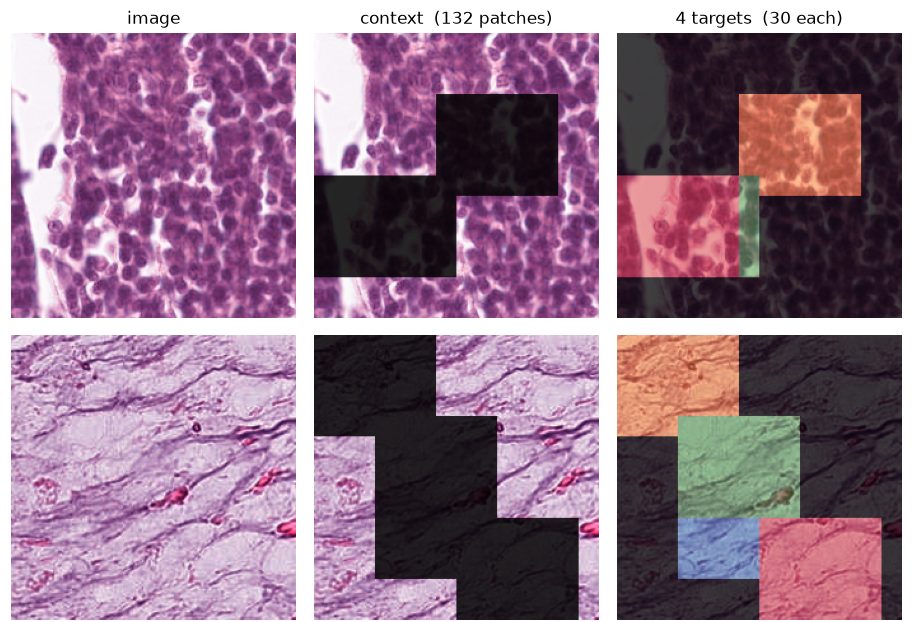
I-JEPA on histology images
Image JEPA (ViT, block masking) pretrained on PathMNIST at 224px on a 24 GB Mac, then frozen-feature probes against a random-init encoder to measure what self-supervision actually buys.
Habits from scientific computing
Measure, don't assume
Build the diagnostic and run it. In ball-in-cup, a probe that was 12× more accurate changed nothing, and only an n=30 closed-loop test showed that.
Explicit over implicit
Typed state, pure transitions, bounded retries. If a system does something, I want to be able to point at the line that made it happen.
Ablate your fixes
When a stack of changes finally works, find out which ones carry the result. Keeping only those is how the next person understands the system.
From PDEs to world models
C, C++ and numerical code
Started programming in scientific computing and never really left it.
M.Sc. Scientific Computing (KTH) · Ph.D. Applied Mathematics (Stockholm University)
Numerical analysis and PDEs.
Postdoc, Memorial University of Newfoundland
Finite-difference and eikonal solvers, later used in seismic inversion workflows.
Scientific researcher, Total E&P USA, Houston
High-performance algorithms for seismic imaging and inversion on HPC clusters, with MPI and CUDA.
Independent AI engineer
LLM agent pipelines for legal documents with schema-validated I/O and auditable outputs. Several agent frameworks built on explicit state machines.
World models and planning
JEPA from scratch: pixels to latent dynamics to MPC, then hyperbolic latents for branching futures.
Want to talk agents or world models?
I'm looking for work in the agent space. The best way to reach me is email.